
Evaporative Air Cooler Manufacturer and Exporter in India
Industrial Evaporative Air Cooler for Efficient and Economical Air Cooling
Vayuvents Pvt. Ltd. is a leading manufacturer and exporter of Evaporative Air Coolers in India, based in Vasai, Maharashtra. We design and manufacture industrial evaporative cooling solutions for factories, warehouses, workshops, production areas, commercial spaces, and other large-volume environments requiring economical air cooling and ventilation.
An Evaporative Air Cooler cools air by using the natural principle of water evaporation. Warm ambient air passes through specially designed wet cooling media, where a portion of the water evaporates and absorbs heat from the incoming air. The resulting air is cooler and is circulated into the required space.
Vayuvents offers different configurations of evaporative air coolers to suit airflow requirements, installation conditions, cooling areas, humidity levels, and industrial applications.
What is an Evaporative Air Cooler?
WHAT IS AN EVAPORATIVE AIR COOLER?
An Evaporative Air Cooler is a cooling system that lowers the temperature of incoming air through the evaporation of water.
Unlike conventional refrigeration-based air-conditioning systems, evaporative coolers do not use a compressor and refrigerant for the basic cooling process. Instead, they use:
- Water
- Cooling pads/media
- Air-moving fan or blower
- Water circulation pump
- Water distribution system
- Control system
CLIMATE DEPENDENCE
The effectiveness of evaporative cooling depends strongly on the ambient dry-bulb temperature and relative humidity. It generally performs best in hot and relatively dry conditions.
IMPORTANT COOLING PARAMETERS
The actual cooling performance of an evaporative air cooler depends on:
- Ambient dry-bulb temperature
- Relative humidity
- Wet-bulb temperature
- Cooling-pad efficiency
- Airflow rate
- Air velocity through the cooling media
- Water distribution
- Fresh-air availability
- Building ventilation
- Outdoor air quality
- Installation arrangement
- Therefore, a cooler should be selected based on the actual site conditions, not simply on room area.
Working Principle of Evaporative Air Cooler
The cooling process is based on the natural phenomenon of evaporative heat transfer.
| Step | Stage | Description |
|---|---|---|
| Step 1 | Warm Air Intake | Hot ambient air is drawn into the cooler through the inlet section. |
| Step 2 | Air Passes Through Wet Media | The incoming air passes through wetted cooling pads. Water is continuously distributed over the pad surface using a pump and water distribution arrangement. |
| Step 3 | Water Evaporation | A portion of the water evaporates into the moving air. Evaporation requires energy, which is taken from the sensible heat of the incoming air. |
| Step 4 | Air Temperature Reduction | As heat is transferred to the evaporating water, the dry-bulb temperature of the air decreases while its moisture content increases. |
| Step 5 | Cool Air Delivery | The cooled air is delivered into the building or process area using an axial fan or blower. |
| Step 6 | Continuous Air Replacement | For effective industrial operation, evaporative cooling systems generally work with adequate air movement and provision for warm air to leave the space. This helps prevent excessive humidity accumulation. |
Key Features of Vayuvents Evaporative Air Cooler
- Designed for large-volume air cooling
- Water-based evaporative cooling
- High airflow capacity
- Low-energy cooling compared with many refrigeration systems
- No conventional refrigerant circuit
- Efficient cooling-pad arrangement
- Robust industrial construction
- Heavy-duty fan or blower
- Continuous water circulation
- Easy water-level management
- Digital or manual controls
- Suitable for industrial environments
- Wall-mounted, ducted, portable, or customized configurations
- Suitable for large open or semi-open spaces
- Low-maintenance cooling system
- Customized airflow and installation options
Technical Specifications of Evaporative Air Cooler
The final specification depends on the required cooling area, airflow, ambient conditions, installation arrangement, and application.
| Parameter | Typical Specification / Options |
|---|---|
| Equipment | Industrial Evaporative Air Cooler |
| Cooling Principle | Evaporative Cooling |
| Airflow Capacity | Application-specific |
| Cooling Media | High-efficiency Evaporative Cooling Pads |
| Fan Type | Axial Fan / Centrifugal Blower |
| Fan Motor | As per airflow requirement |
| Motor Power | Application-specific |
| Air Delivery | Direct / Ducted |
| Water Pump | Suitable circulation pump |
| Water Distribution | Continuous / Controlled |
| Tank Capacity | Model-dependent |
| Operating Temperature | Ambient-dependent |
| Control System | Manual / Digital / Automatic |
| Fan Speed Control | Fixed / Multi-Speed / VFD, as required |
| Body Material | GI / MS / SS / FRP / Suitable Material |
| Cooling Pad Material | Cellulose / Suitable Evaporative Media |
| Installation | Floor / Wall / Roof / Ducted |
| Air Direction | Horizontal / Vertical / Customized |
| Power Supply | As per requirement |
| Frequency | 50 Hz / 60 Hz |
| Water Supply | Manual / Automatic |
| Water Level Control | Float Valve / Automatic |
| Drain Arrangement | Provided as required |
| Application | Industrial / Commercial / Warehouse |
| Customization | Available |
Types of Evaporative Air Cooler
An Industrial Evaporative Air Cooler is designed for large manufacturing areas, workshops, warehouses, and production facilities.
It provides high-volume air movement and evaporative cooling for spaces where conventional air conditioning may be expensive or impractical.
Applications
- Manufacturing plants
- Workshops
- Warehouses
- Production halls
- Industrial sheds
- Assembly areas
Desert-type coolers are designed for high-volume air delivery and are generally suited to hot and relatively dry climatic conditions.
They are commonly used in large rooms, industrial spaces, workshops, and commercial areas.
A ducted evaporative cooler distributes cooled air through a duct network.
This configuration allows the cooling system to supply air to selected zones or specific work areas.
Applications
- Factories
- Production lines
- Warehouses
- Large commercial spaces
- Industrial workstations
In a direct evaporative cooling system, ambient air passes directly through wet cooling media and the cooled air is supplied to the occupied space.
The air temperature decreases while its moisture content increases.
This configuration is particularly effective where the climate is hot and relatively dry.
An indirect evaporative cooling arrangement cools the supply air without directly adding the evaporated water to the air stream in the same way as direct evaporative cooling.
This configuration can be considered when lower humidity addition is important.
The system design is more complex and depends on the required cooling performance and application.
Portable evaporative coolers are compact units designed for localized cooling.
They can be moved between workstations or areas where temporary cooling is required.
Applications
- Workshops
- Small production areas
- Maintenance areas
- Outdoor work areas
- Temporary workstations
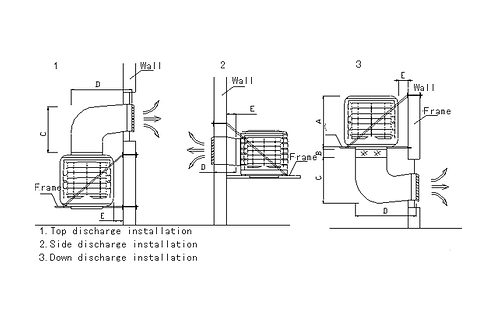
Wall-mounted evaporative coolers are installed through or against an external wall.
They can save floor space and provide direct cooling into the working area.
Applications
- Factories
- Workshops
- Warehouses
- Commercial buildings
- Industrial sheds
Roof-mounted units can supply cooled air to large industrial areas through suitable ducting or direct discharge arrangements.
They are useful where floor space is limited.
High-airflow models are designed for large-volume air movement and can be used in expansive industrial spaces.
They are selected based on the required air changes, heat load, building volume, and ventilation arrangement.
Industrial Uses of Evaporative Air Cooler
Evaporative air coolers are widely used in manufacturing plants where large production areas need economical air cooling. Suitable areas include:
- Production floors
- Assembly areas
- Machine shops
- Workstations
- Packaging areas
- Inspection areas
Automobile manufacturing and component facilities can use evaporative cooling for:
- Assembly areas
- Component manufacturing
- Welding areas
- Inspection sections
- Warehouses
- General production spaces
Textile manufacturing plants often have large floor areas and significant internal heat loads. Evaporative cooling can be used in:
- Spinning areas
- Weaving sections
- Processing areas
- Garment production
- Packing areas
- Storage areas
Engineering workshops can use evaporative coolers to improve thermal comfort in:
- Fabrication shops
- Machining areas
- Assembly sections
- Welding areas
- Maintenance workshops
- Production floors
Large warehouses can become hot because of roof heat gain and limited natural ventilation. Evaporative coolers can provide high-volume air movement and cooling for:
- Storage areas
- Dispatch areas
- Loading zones
- Packing sections
- Logistics warehouses
Foundries and metalworking plants can experience significant heat generation. Evaporative cooling can be used in suitable areas such as:
- Operator workstations
- Inspection areas
- Auxiliary production zones
- Maintenance areas
- Cooling/ventilation zones
- For very high-temperature process areas, cooling equipment should be designed to account for the process heat load and safety conditions.
Evaporative cooling can be used for suitable food-processing areas where increased humidity is acceptable and hygienic design requirements are met. Applications may include:
- Production areas
- Packaging areas
- Storage areas
- Processing halls
Evaporative cooling may be suitable for selected non-critical spaces such as:
- Warehouses
- Utility areas
- General work areas
- Packaging support areas
- Critical controlled environments typically require HVAC systems capable of precise temperature and humidity control.
Plastic processing plants can use evaporative coolers for general production areas, assembly spaces, warehouses, and worker comfort zones.
Evaporative cooling can be applied to suitable production and working areas where the ambient conditions permit effective evaporative operation.
Large paper and packaging plants can use evaporative coolers in:
- Production areas
- Packing sections
- Storage spaces
- Dispatch areas
- Worker zones
Evaporative cooling can be considered for:
- Large halls
- Workshops
- Commercial spaces
- Educational facilities
- Community spaces
- Semi-open areas
Advantages of Evaporative Air Cooler
LOWER ENERGY CONSUMPTION
Evaporative cooling uses water evaporation rather than a conventional compressor-based refrigeration cycle, which can reduce electrical energy consumption in suitable climates and applications.
HIGH AIR VOLUME
Industrial evaporative coolers can move large quantities of air, making them suitable for large spaces.
ECONOMICAL COOLING
For suitable hot and relatively dry conditions, evaporative cooling can provide a cost-effective alternative to full-space mechanical air conditioning.
FRESH-AIR COOLING
Many industrial evaporative cooling arrangements supply a high volume of outdoor air rather than repeatedly recirculating indoor air.
NO CONVENTIONAL REFRIGERANT CIRCUIT
Direct evaporative cooling does not require a compressor-based refrigerant circuit.
EASY INSTALLATION
Depending on the configuration, units can be floor-mounted, wall-mounted, roof-mounted, or connected to ducting.
SUITABLE FOR LARGE INDUSTRIAL SPACES
Evaporative cooling is particularly useful for factories, workshops, warehouses, and other large-volume areas.
SIMPLE MAINTENANCE
Routine maintenance generally includes cleaning the cooling media, checking the water system, cleaning the tank, inspecting the fan, and maintaining the pump and electrical components.
Evaporative Air Cooler vs Conventional Air Conditioner
| Feature | Evaporative Air Cooler | Refrigeration-Based AC |
|---|---|---|
| Cooling Method | Water evaporation | Refrigeration cycle |
| Compressor | Not required for direct evaporative cooling | Required |
| Refrigerant | Not required for direct evaporative cooling | Used |
| Fresh Air | High outdoor-air operation possible | Usually recirculates a significant portion of indoor air |
| Humidity | Increases in direct evaporative cooling | Can dehumidify |
| Best Climate | Hot and relatively dry | Broad range of climates |
| Large Industrial Area | Highly suitable in appropriate conditions | Can be expensive at large scale |
| Energy Requirement | Generally lower for suitable applications | Generally higher |
| Ventilation | Strong fresh-air capability | Depends on HVAC design |
Cooling Performance & Maintenance
FACTORS AFFECTING COOLING PERFORMANCE
Evaporative cooling does not provide the same result under every weather condition.
- Relative Humidity – lower relative humidity generally provides greater evaporative cooling potential.
- Ambient Temperature – higher outdoor temperatures generally provide more sensible cooling potential when sufficient evaporative capacity is available.
- Cooling Pad Efficiency – the quality, thickness, surface area, and condition of the cooling media affect performance.
- Airflow – the amount and velocity of air passing through the cooling media influence cooling performance.
- Water Distribution – uniform wetting of the cooling media is important for effective evaporation.
- Building Ventilation – the cooled air needs an appropriate path through the building, with warm and humid air able to leave the space.
WATER MANAGEMENT AND MAINTENANCE
Regular maintenance helps maintain cooling performance and equipment life. Important maintenance activities include:
- Cleaning the water tank
- Checking water quality
- Cleaning or replacing cooling pads when required
- Inspecting the water pump
- Checking water distribution
- Cleaning fan blades
- Checking motor bearings where applicable
- Inspecting electrical connections
- Checking float valve operation
- Cleaning filters or inlet screens
- Checking drain arrangements
- Water quality is particularly important because mineral deposits can accumulate on cooling media and water-contact components.
Customization, Quality & Why Choose Vayuvents
CUSTOMIZED EVAPORATIVE AIR COOLER
Vayuvents Pvt. Ltd. offers customized evaporative cooling solutions based on:
Area Volume → Heat Load → Required Airflow → Ambient Conditions → Humidity → Installation → Air Distribution
Customization may include:
- Airflow capacity
- Fan/blower selection
- Cooling-pad size
- Water tank capacity
- Pump capacity
- Body material
- Duct connection
- Air outlet direction
- Wall or roof mounting
- Control panel
- Variable-speed operation
- Automatic water-level control
- Drain system
- Customized dimensions
QUALITY MANUFACTURING AT VAYUVENTS
At Vayuvents Pvt. Ltd., evaporative air cooling systems are designed with attention to airflow, water distribution, cooling media performance, structural strength, electrical safety, and installation requirements.
Our objective is to provide practical cooling solutions that combine high-volume air movement, effective evaporative cooling, low operating energy, and dependable industrial performance.
WHY CHOOSE VAYUVENTS PVT. LTD.?
- Leading Evaporative Air Cooler Manufacturer in India
- Evaporative Air Cooler Exporter
- Based in Vasai, Maharashtra
- Industrial cooling expertise
- High-airflow cooling solutions
- Customized cooler configurations
- Multiple installation options
- Robust construction
- Efficient water circulation
- Application-based fan selection
- Suitable for factories and warehouses
- Technical support for cooling-system selection
- Customized air distribution solutions
APPLICATIONS AT A GLANCE
Factory Cooling | Industrial Cooling | Warehouse Cooling | Workshop Cooling | Production Area Cooling | Textile Industry | Automobile Industry | Engineering Industry | Foundry | Packaging Industry | Plastic Industry | Rubber Industry | Commercial Cooling | Large Hall Cooling
GET A CUSTOMIZED EVAPORATIVE AIR COOLING SOLUTION
If you are looking for an Evaporative Air Cooler Manufacturer and Exporter in India, Vayuvents Pvt. Ltd. provides industrial cooling solutions for factories, warehouses, workshops, production areas, and large commercial spaces.
Whether you need a High-Airflow Industrial Evaporative Air Cooler, Ducted Evaporative Cooler, Wall-Mounted Cooler, Roof-Mounted Cooler, Portable Cooler, or Customized Evaporative Cooling System, Vayuvents can develop the equipment according to your airflow and site requirements.
Contact Vayuvents Pvt. Ltd., Vasai, Maharashtra, India, for your Industrial Evaporative Air Cooler requirement.
Our Evaporative Air Cooler Range

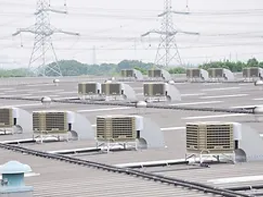
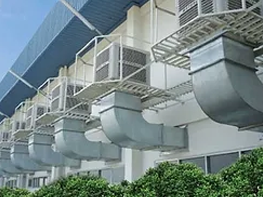
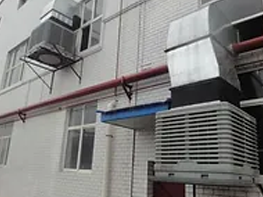
Successfully Installed at Customer Sites
Frequently Asked Questions
An Evaporative Air Cooler is an energy-efficient cooling system that uses the natural process of water evaporation to reduce air temperature. As explained on the page, warm air is drawn through water-saturated cooling pads, where heat is absorbed and the air gets cooled before being circulated into the space. Unlike traditional air conditioners, an Evaporative Air Cooler manufacturer designs these systems without refrigerants, making them eco-friendly and cost-effective. This cooling method is highly effective in hot and dry climates, ensuring fresh air circulation and improved indoor air quality, which makes it a preferred solution for industrial and commercial applications.
Choosing an Evaporative Air Cooler supplier offers several advantages over conventional AC systems. These coolers consume significantly less electricity, operate on a natural cooling process, and continuously supply fresh air instead of recirculating indoor air. A reliable Evaporative Air Cooler manufacturer ensures systems that are easy to install, require minimal maintenance, and are more environmentally sustainable. Additionally, businesses looking for large-area cooling solutions often prefer evaporative cooling due to its lower operational costs and ability to handle high airflow requirements efficiently.
A trusted Evaporative Air Cooler exporter supplies these systems to a wide range of industries, including manufacturing plants, warehouses, workshops, foundries, and commercial facilities. These coolers are especially suitable for large open areas where traditional air conditioning is not practical. An experienced Evaporative Air Cooler manufacturer designs industrial models with high airflow capacity, durable components, and efficient cooling performance, making them ideal for heavy-duty applications and continuous operation in demanding environments.
When choosing an Evaporative Air Cooler supplier, it is important to evaluate factors such as airflow capacity (CMH), cooling area coverage, energy consumption, and build quality. As seen on the page, different models offer varying airflow and cooling capacities to suit diverse industrial needs. A professional Evaporative Air Cooler exporter will also provide technical support, installation guidance, and after-sales service. Partnering with a reputed Evaporative Air Cooler manufacturer ensures high-quality products, compliance with industry standards, and long-term reliability for your cooling requirements.