
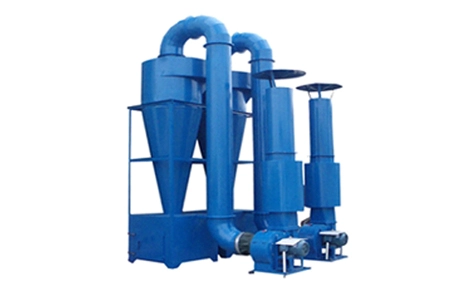
Tangential entry cyclone dust collectors — the standard industrial configuration for maximum centrifugal spin velocity and separation efficiency. MS, FRP, SS, PP construction. 200 mm to 2,500 mm body diameter. IS 6394 compliant. Manufacturer from Mumbai.
Tangential Cyclone Dust Collector — Manufacturer & Supplier, India
Vayuvents manufactures Tangential Entry Cyclone Dust Collectors — standard tangential inlet design for maximum centrifugal separation efficiency. MS, FRP, PP, SS construction. IS 6394. Mumbai. Call +91 90961 88703.
A Tangential Cyclone Dust Collector uses a tangential inlet — the duct enters the cyclone body at a tangent to the circular cross-section, directing the incoming dusty airstream immediately into rotational motion around the cyclone wall. This tangential entry is the standard, most common cyclone configuration for industrial dust collection worldwide.
The tangential entry creates higher rotational velocity at the cyclone wall compared to axial entry designs, resulting in stronger centrifugal force on the dust particles and higher separation efficiency — particularly for the mid-size particles (5 to 20 microns) that are most difficult to separate by centrifugal means.
Vayuvents manufactures tangential cyclone dust collectors in body diameters from 200 mm to 2,500 mm. The inlet duct cross-section is sized to achieve 15 to 20 m/s inlet velocity — the optimum range for maximum centrifugal separation efficiency without excessive pressure drop. Custom inlet angles (15° to 30° taper) are available for maximum spin induction.
Available in MS (standard up to 350°C), SS304 (food and pharmaceutical), FRP (chemical and corrosive), and PP (chemical below 60°C) construction. Abrasion-resistant cone liner for high-wear applications.
Key Features & Benefits
No Moving Parts
No filter media, no bags, no moving internal parts — zero maintenance consumables. Collection efficiency remains constant throughout service life unlike bag filters that degrade.
High-Temperature Service
MS cyclone handles dusty airstreams up to 350°C — where fabric bag filters cannot be used. Refractory-lined cyclone for up to 500°C cement kiln and furnace gas service.
Handles Abrasive Dust
Handles abrasive silica, coal, and metal grinding dust where bag filter media would rapidly abrade. Abrasion-resistant liner in the cone extends service life in very abrasive service.
High-Volume Capacity
Multi-cyclone battery arrangements handle airflows up to 1,00,000 m³/hr — scalable by adding cyclone cells in parallel.
Compact Installation
Vertical cylinder profile with small footprint — installs within existing building structures without major civil works.
Simple Maintenance
Periodic inspection of cone for wear (annual), hopper emptying (daily to weekly), and rotary valve maintenance. No filter bags to replace.
Dust Recovery
Separated dust collected dry and clean in hopper — recoverable as raw material (cement, grain husk) or fuel (biomass, coal).
CPCB Compliant
Designed as primary separator before bag filter/ESP — combined system meets CPCB outlet concentration standards.
Technical Specifications
| Parameter | Specification |
|---|---|
| Inlet Velocity | 12 to 20 m/s for efficient centrifugal separation |
| Collection Efficiency | 70 to 95% for particles above 10 microns |
| Body Diameter | 200 mm to 2,500 mm |
| Airflow Capacity | 500 to 1,00,000 m³/hr per unit |
| Body Material | MS / SS304 / FRP / PP |
| Cone Thickness | 6 to 12 mm MS (abrasion service) |
| Temperature Range | Up to 350°C (MS) | Up to 500°C (refractory lined) |
| Dust Discharge | Rotary airlock valve / Manual dump valve |
| Standards | IS 6394 | IS 4894 | PCB emission norms |
Product Images
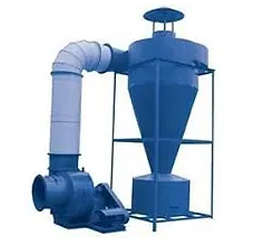

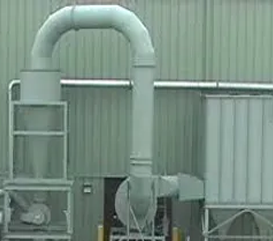
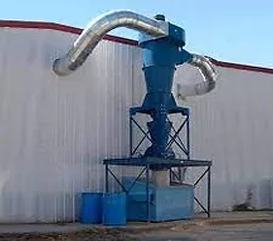
Where It Is Used
- Cement plants — raw mill, kiln, and cement mill dust pre-separation
- Biomass boilers — rice husk, bagasse, and wood chip flyash pre-separation
- Woodworking — sawdust and chip primary recovery before bag filter
- Grain and rice mills — rice husk, bran, and grain chaff separation
- Metal grinding and shot blasting — coarse metal dust and shot media recovery
- Stone crushing — limestone, granite, and aggregate coarse dust pre-separation
- Plastic and rubber — granule fines and carbon black pre-separation
- Fertiliser plants — dust pre-separation at product transfer points
- Chemical plants — coarse powder recovery before fine filtration
- Steel plants — raw material handling dust pre-separation
- Coal handling plants — coal dust pre-separation before bag filter or ESP
- Agricultural processing — husk, chaff, and crop residue separation
FAQs — Tangential Cyclone Dust Collector
A cyclone dust collector uses centrifugal force — not filter media — to separate dust from the airstream. Dust-laden air enters tangentially at the top, creating a spinning helical flow. Heavier dust particles are thrown outward by centrifugal force to the cyclone wall, spiral down into the collection hopper, and exit through the bottom. Clean air exits upward through the central vortex outlet at the top. The collection efficiency depends on particle size and density — cyclones are very effective above 10 microns and less effective below 5 microns.
For typical industrial dust (coarse fraction above 10 microns), a well-designed cyclone achieves 70 to 90% mass separation efficiency. High-efficiency multi-cyclone units achieve 90 to 95% for particles above 5 microns. The sub-5 micron fraction (which carries most of the health risk) requires a downstream bag filter or ESP for final separation. Cyclones are used as pre-separators to protect and extend the life of downstream fine filtration equipment.
A single cyclone typically reduces outlet concentration to 200 to 500 mg/m³ from inlet loadings of 5,000 to 20,000 mg/m³ — still above the CPCB limit of 50 mg/m³ for most industrial stacks. Cyclones are therefore used as the first stage before a bag filter or ESP that achieves final CPCB compliance. Only in special cases (very coarse dust, low inlet loading) can a high-efficiency multi-cyclone alone meet emission standards.
Installing a cyclone pre-separator before a bag filter provides three major benefits: (1) removes 70 to 90% of the inlet dust mass, dramatically reducing bag filter dust loading and extending bag life 2 to 4 times; (2) removes coarse abrasive particles that would abrade the bag filter casing and bags; (3) enables the bag filter to be sized smaller (lower capital cost) because it only needs to handle the residual fine fraction after cyclone separation.
For cement plant raw meal, cement, and fly ash service: minimum 6mm MS plate for the body and 8 to 10mm for the cone. For highly abrasive feeds (silica, coal): a replaceable abrasion-resistant liner (rubber, ceramic tiles, or chrome-carbide plate) in the lower cone. For cement kiln exit gas above 200°C: refractory-lined cyclone with castable refractory in the body and cone. Vayuvents recommends the appropriate construction for your specific process.
All cyclones use tangential air entry — the inlet duct enters the cyclone at a tangent to the cyclone body, creating the spinning motion needed for centrifugal separation. The term 'tangential cyclone' distinguishes this standard configuration from the less common axial entry cyclone, where air enters along the cyclone axis and is deflected into rotation by internal vanes. Vayuvents manufactures tangential entry cyclones as the standard configuration for all industrial applications.
Contact Vayuvents at enquiry@vayuvents.com or call +91 90961 88703. Share the dust type and particle size distribution, airflow in m³/hr, inlet dust loading in g/m³, gas temperature, and CPCB emission requirement. We will size the correct cyclone or multi-cyclone battery and provide a technical and commercial proposal within 24 hours.