
Turbo Ventilator — Manufacturer & Supplier, India
Vayuvents supplies Turbo Ventilators — wind-driven and motorised rooftop ventilators for industrial and commercial building natural ventilation. 300 mm to 1,000 mm dia. Mumbai. Call +91 90961 88703.
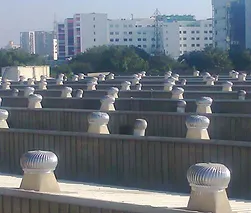
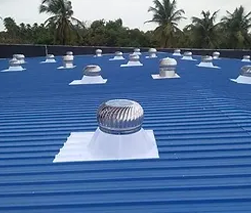
A Turbo Ventilator is a rooftop ventilation unit that uses aerodynamic rotating vanes to exhaust hot and stale air from buildings. The term covers both wind-driven turbine ventilators (no motor, wind energy only) and motorised turbo ventilators (electric motor assisted for reliable performance regardless of wind).
Vayuvents supplies turbo ventilators from 300 mm to 1,000 mm diameter in aluminium and GI construction. The sealed maintenance-free bearing design and aerodynamic vane profile ensure low starting resistance and smooth continuous rotation in variable Indian wind conditions.
For buildings requiring consistent exhaust ventilation with defined air change rates, motorised turbo ventilators or standard motorised roof ventilator fans are recommended. Wind-driven turbo ventilators are suited for warehouses, sheds, and agricultural buildings where supplementary natural ventilation at zero operating cost is the requirement.
Vayuvents advises on the correct ventilator type for your specific building and heat load — contact us for a free assessment and ventilation sizing calculation.
Key Features & Benefits
Rooftop Heat Extraction
Extracts hot accumulated air from the roof level directly — removing the heat stratification layer that makes factory floors uncomfortable and reduces worker productivity.
Weatherproof Cowl
Integrated aerodynamic weather cowl with rain deflector prevents rain, bird entry, and wind-driven debris from entering the building through the roof opening.
Motorised Operation
Electric motor-driven impeller provides consistent, controlled exhaust airflow regardless of wind speed or direction — unlike wind-driven turbo ventilators that stop in calm weather.
IP55 Motor
IP55 TEFC motor withstands the rooftop environment — direct sunlight, rain, dust, and temperature extremes without motor winding failure.
Wide Size Range
300 mm to 1,800 mm throat diameter covers 2,500 m³/hr to 75,000 m³/hr per unit — single or multiple units to match any building exhaust requirement.
Material Options
GI, MS, SS304, aluminium, and FRP cowl and casing options for corrosive chemical plant, coastal, food processing, and pharmaceutical rooftop environments.
Low Noise
Carefully selected impeller speed and aerodynamic blade profiles minimise noise — suitable for factories in residential proximity and noise-sensitive manufacturing environments.
IS 3588 Compliant
Airflow and pressure performance tested per IS 3588-1987 with test certificate confirming stated exhaust performance.
Technical Specifications
| Parameter | Specification |
|---|---|
| Rotor Diameter | 300 mm to 1,000 mm |
| Drive | Wind-driven (standard) / Motor-assisted (optional) |
| Material | Aluminium alloy / GI |
| Bearings | Sealed, maintenance-free |
| Start Wind Speed | 2 to 3 km/hr |
| Estimated Airflow | 500 to 8,000 m³/hr (wind dependent) |
| Maintenance | Nil (sealed bearings, inspect after 5-7 years) |
| Standards | IS 3588-1987 |
Airflow Performance — Model Range
| Wind Velocity | 8 KM/HR | ||
|---|---|---|---|
| Model | Wind Ventilator Size | Height | Exhaust Capacity (CFM) |
| TRV-24 | 24 inches | 20 Ft | 1,972 |
| 30 Ft | 2,076 | ||
| 40 Ft | 2,164 | ||
| Specification | Details |
|---|---|
| MOC of Vanes | SS304 |
| MOC of Top Plate | SS304 (0.5mm) |
| MOC Bottom of Ring | SS304 (0.5mm) |
| Weight of Ventilator | 08 Kg |
| Height of Ventilator | 410 mm ± 5 mm |
| Centre Width of Ventilator | 735 mm ± 5 mm |
| Dia of Top Plate | 500 mm ± 5 mm |
| Dia of Bottom Ring | 600 mm ± 15 mm |
| Number of Vanes | 42 Nos Rolled Formed with Lock Washer |
| Thickness of Vanes | 0.5 mm |
| Number of Bearings | 02 Nos |
| Bearing Type | SKF 6001 ZZ Permanently Lubricated & Sealed |
- Performance at 8 km/hr wind velocity.
- Higher wind speeds increase exhaust capacity proportionally.
- Available in 18", 21", 24" diameter sizes.
Product Images
Where It Is Used
- Warehouses and storage facilities — natural rooftop air movement
- Light industrial sheds — background ventilation supplementing wall openings
- Agricultural buildings — cattle shed, poultry farm, and grain store ventilation
- School and commercial buildings — low-cost natural rooftop ventilation
- Construction site temporary sheds — worker area heat removal without power
- Automotive showrooms — supplementary background rooftop ventilation
- Sports halls and assembly halls — natural rooftop heat exhaust
- Rural and peri-urban buildings — ventilation without electrical installation
You May Also Need
Wind Turbo Roof Ventilator
Wind-driven turbine ventilator for zero-energy natural building ventilation.
View Details →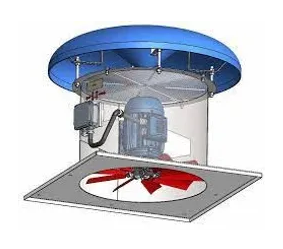
Motorized Roof Ventilator
Electric motor driven for reliable defined airflow in factories.
View Details →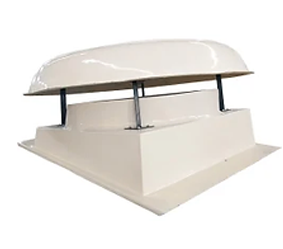
FAQs — Turbo Ventilator
A motorised roof ventilator is powered by an electric motor — it exhausts a fixed, controlled volume of air regardless of outdoor wind speed or direction. A wind-driven turbo ventilator (turbine ventilator) relies entirely on wind energy and provides no airflow in calm weather. For reliable, consistent exhaust ventilation in factories and industrial buildings, motorised roof ventilators are always recommended over wind-driven units.
For a 10,000 sq m factory with 8 metre ceiling height requiring 6 air changes per hour, the total exhaust airflow needed is approximately 480,000 m³/hr. This requires 8 to 12 units of RV-100-96-1800 (75,000 m³/hr each) or 12 to 16 units of RV-750-14-1500 (55,000 m³/hr each), arranged uniformly across the roof to avoid stagnant pockets. Vayuvents provides free layout and sizing calculations based on your building dimensions and required air change rate.
For standard factory and warehouse use, GI (galvanised iron) sheet cowl is supplied. For chemical plant rooftops with corrosive acid fumes, coastal environments, and food processing plants, FRP (fibre-reinforced plastic) or SS304 cowl and casing are available. The blade material is also matched — aluminium for standard duty, FRP for corrosive service. Please specify the corrosive agent when requesting a quotation.
Standard motorised roof ventilators are rated for normal temperature exhaust service only and should not be used as fire smoke exhaust fans unless specifically designed and certified for that purpose. Fire smoke exhaust fans require high-temperature motor ratings (typically 300°C for 2 hours), smoke-rated bearings, and fire damper integration per NBC 2016 requirements. Vayuvents can supply dedicated smoke exhaust fan variants — please specify if fire smoke extraction is required.
Roof ventilators should be spaced at maximum 10 to 15 times the ceiling height — for an 8 metre ceiling, maximum 80 to 120 metre spacing. They should be distributed uniformly across the roof to avoid stagnant areas and positioned at the ridge or highest roof point where hot air naturally accumulates. Corresponding fresh air supply openings (louvres or supply fans) should be provided at low level on the opposite side of the building.
Yes. For foundry and forge buildings with high heat loads, Vayuvents supplies heavy-duty roof ventilators with Class H motor insulation (180°C winding rating) for the high ambient temperature at roof level in these buildings. The cowl is in MS with heat-resistant paint for the elevated roof ambient. Anti-corrosion and spark-resistant blade options are available for foundry environments.
Contact Vayuvents at enquiry@vayuvents.com or call +91 90961 88703. Share the building dimensions (length × width × height), required air changes per hour, roof type (sheeted, RCC, sawtooth), and any special requirements (corrosion, high temperature, food grade). We will calculate the required number and size of units and provide a layout drawing and commercial proposal within 24 hours.