Motorised Roof Ventilator for Factory — Manufacturer & Supplier
Vayuvents Pvt. Ltd. manufactures and supplies motorised roof ventilators for factory rooftop heat extraction — working in combination with floor-level supply fans to create a complete factory ventilation system that removes accumulated heat from the building.
Hot air naturally rises and accumulates at the highest point in a factory building — the roof ridge. This creates a layer of overheated air that gradually descends, raising the entire factory ambient temperature. Motorised roof ventilators positioned at the highest point of the roof extract this accumulated hot air directly from the zone where it is hottest, creating a natural chimney effect supplemented by the electric motor.
Combining motorised roof ventilators for hot air exhaust with floor-level axial supply fans or natural air inlets creates a balanced ventilation system that continuously replaces hot factory air with fresh outdoor air — the most effective and energy-efficient approach to factory temperature management.
Vayuvents has supplied motorised roof ventilators to automotive, engineering, textile, pharmaceutical, and food processing factories across India — from simple 300mm throat fans for small workshops to 1,800mm throat units for large automotive and steel plants.
How It Works in This Application
Heat Accumulation at Roof Level
Hot air from machinery, furnaces, and processes rises by buoyancy and accumulates in the space immediately below the factory roof, reaching temperatures 10 to 20 degrees Celsius above floor level.
Motorised Extraction
The electrically-driven roof ventilator impeller creates a suction that draws hot accumulated air upward through the fan throat and discharges it to the outdoor atmosphere above the roof level.
Replacement Air Entry
As hot air is extracted from the roof, replacement fresh air enters through open wall vents, louvres, or supply fans at floor level — completing the ventilation air change cycle.
Continuous Temperature Reduction
Continuous extraction of hot air and replacement with cooler outdoor air progressively reduces the factory ambient temperature, improving worker comfort and machinery operating conditions.
Recommended Variants
Standard Motorised Roof Ventilator
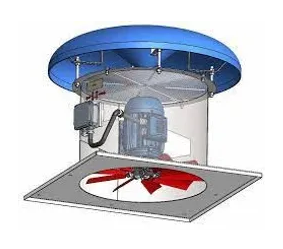
Direct-drive axial impeller on roof-mounted motor — simplest, most common configuration for factory heat extraction.
Most RecommendedCentrifugal Roof Exhaust Fan
Centrifugal impeller for higher static pressure when long internal ductwork connects to the roof unit.
High-Temperature Roof Ventilator
High-temp motor and bearing for foundry, forge, and kitchen exhaust at elevated temperatures.
SS Construction Roof Ventilator
Stainless steel body and impeller for corrosive environments — chemical plants, pharma, and coastal factories.
Technical Specifications
| Parameter | Specification |
|---|---|
| Airflow Capacity | 500 to 1,00,000 m3/hr |
| Static Pressure | Up to 50 mmWG |
| Motor Power | 0.18 to 22 kW |
| Throat Diameter | 300 to 1,800 mm |
| Body Material | GI / Aluminium / SS304 |
| Motor Enclosure | IP55 TEFC as standard |
| Standards | IS 4894, IS 6966 |
Key Features
- Direct-drive motor eliminates belts and pulleys — no belt slippage, no periodic belt replacement required
- IP55 weatherproof motor as standard for outdoor roof mounting in all weather conditions
- Birdproof wire mesh guard prevents nesting and debris ingress into the fan throat
- GI, aluminium, and SS body options to match building structure material and process environment
- Integrated rainhood prevents rain ingress into the factory during fan-off periods
- Low-profile design minimises wind load and visual impact on the building roofline
- Thermal overload protection built into motor starter for safe unattended 24/7 operation
- Available with manual or automatic thermostat-controlled on/off for energy-efficient operation
Industries That Use This Application
Automotive Plants
Assembly shop, body shop, and paint shop heat extraction in automotive manufacturing facilities
Forging & Foundry
Intense heat extraction from forge shop and foundry roof — critical for worker safety in extreme heat environments
Engineering Workshops
General workshop heat extraction from machine shops, fabrication shops, and maintenance facilities
Textile Mills
Spinning and weaving mill heat extraction — particularly important for cotton mills where heat and humidity management is critical
Pharmaceuticals
Pharmaceutical manufacturing building heat extraction from tablet compression, granulation, and packaging areas
Food Processing
Heat extraction from cooking, baking, and processing areas in food manufacturing facilities
Steel Fabrication
Heat from welding, cutting, and grinding operations in steel fabrication workshops
General Manufacturing
All-purpose factory heat extraction for light and medium manufacturing facilities across industry sectors
✓ Supply & Support: Vayuvents manufactures motorised roof ventilators at our Vasai, Mumbai works. We supply complete units ready for installation with integral rainhood, birdguard, and curb. Installation supervision and AMC available across India.
FAQs
The motorised roof ventilator extracts hot air that has accumulated at the highest point of the factory roof — the zone that is 10 to 20 degrees Celsius hotter than floor level due to buoyancy stratification. By continuously removing this hot air layer, the factory ambient temperature progressively decreases. Working in combination with floor-level supply fans that introduce fresh outdoor air, a well-designed factory ventilation system can reduce ambient temperature by 5 to 10 degrees Celsius.
The number depends on the factory floor area, heat load from machinery and processes, and the required air change rate. As a general guide, 10 to 20 air changes per hour is recommended for factories with high heat loads. For a 2,000 sq m factory with 8m height, this requires 1,60,000 to 3,20,000 m3/hr of exhaust capacity, typically provided by 4 to 8 roof ventilators. Vayuvents provides heat load calculations for your specific factory.
A natural (wind-driven or thermal) roof ventilator relies on wind pressure difference and thermal buoyancy to create airflow — it requires no power but provides limited and variable airflow. A motorised roof ventilator uses an electric motor to drive the impeller, providing consistent, controllable, and much higher airflow regardless of wind conditions. Motorised units are recommended for factories with significant heat loads where reliable ventilation is critical.
The required size depends on the required airflow per unit and the number of units. Larger throat diameters (1,200 to 1,800mm) are more efficient per unit but require larger roof opening. Smaller throat diameters (300 to 600mm) are used where roof structure limits opening size. Vayuvents selects the correct size based on your required airflow, roof structure, and installation constraints.
Yes. Motorised roof ventilators supplement local exhaust ventilation (welding booth fans) by exhausting welding fumes and general factory air contamination from the roof. However, for welding fume control at source, dedicated local exhaust ventilation at the welding booth is required — the roof ventilator handles residual fumes that escape local capture.
Yes. For factories in coastal locations or chemical processing environments, Vayuvents supplies motorised roof ventilators in stainless steel (SS304 or SS316) body and impeller construction. For mildly corrosive environments, GI construction with anti-corrosion coating is available.
Contact Vayuvents at enquiry@vayuvents.com or call +91 90961 88703. Share your factory dimensions (L x W x H), number and type of heat-generating equipment, and number of existing openings. We will calculate the required ventilation rate and recommend the correct number and size of roof ventilators with a full commercial proposal within 24 hours.