Motorised Roof Ventilator for Food Processing — Manufacturer & Supplier
Vayuvents Pvt. Ltd. manufactures and supplies motorised roof ventilators for food processing plants — extracting heat, steam, cooking odours, and humid air from bakeries, dairy plants, canneries, beverage manufacturing, and food processing facilities.
Food processing plants generate significant heat and steam from cooking, baking, pasteurisation, sterilisation, and processing operations. This heat and humidity accumulates at the building roof level, creating condensation risk, mould growth potential, and uncomfortable working conditions. Motorised roof ventilators exhausting this humid hot air from the roof apex are the most effective and energy-efficient approach to managing food plant building environment.
Food processing plant roof ventilators must meet additional hygiene requirements compared to standard industrial ventilators — they must not create conditions that allow contamination of food processing areas, must be constructed from materials that resist the corrosive steam and condensate environment, and must be maintainable without creating cross-contamination risk during cleaning.
Vayuvents supplies GI, aluminium, and SS roof ventilators for different food processing applications — recommending the appropriate material based on the specific food production environment and FSSAI hygiene requirements.
How It Works in This Application
Steam and Heat Generation
Cooking kettles, retorts, pasteurisers, ovens, and spray dryers generate large quantities of steam and heat that rise rapidly to the building roof level.
Moisture and Condensation Risk
Steam condenses on cold roof structure, purlins, and equipment if not rapidly exhausted — creating water droplets that can fall onto exposed food product and create food safety risk.
Roof Ventilator Exhaust
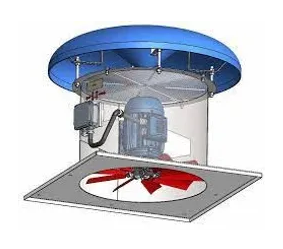
Motorised roof ventilators positioned at the roof apex continuously extract humid hot air before it can condense on the structure, discharging it safely to atmosphere above the building.
Fresh Air Replacement
Replacement fresh air from wall openings or supply fans provides fresh, dry air to the food processing area, reducing humidity and improving working conditions.
Recommended Variants
GI Standard Roof Ventilator
Hot-dip galvanised construction for general food plant buildings with steam and heat exhaust requirement.
Most RecommendedSS304 Roof Ventilator
Stainless steel construction for food processing areas where corrosive steam and food acid condensate is present.
Aluminium Roof Ventilator
Lightweight aluminium body and impeller for food plants requiring lighter roof loading and corrosion resistance.
VFD-Controlled Roof Ventilator
Variable speed operation controlled by humidity sensor for precise food plant humidity management.
Technical Specifications
| Parameter | Specification |
|---|---|
| Airflow Capacity | 1,000 to 50,000 m3/hr |
| Static Pressure | Up to 40 mmWG |
| Motor Power | 0.18 to 11 kW |
| Throat Diameter | 400 to 1,400 mm |
| Body Material | GI (hot-dip galvanised) / Aluminium / SS304 |
| Motor Enclosure | IP55 TEFC |
| Standards | IS 4894, IS 6966, FSSAI guidelines |
Key Features
- Hot-dip galvanised GI or SS304 construction resists the corrosive condensate from steam-laden food processing atmospheres
- Smooth internal surfaces prevent food product or contamination accumulation in the fan throat
- Birdproof mesh guard with corrosion-resistant frame prevents nesting that could create contamination risk
- IP55 motor enclosure withstands the high-humidity condensate-rich environment of food factory rooftops
- Integral rainhood in matching corrosion-resistant material prevents rain ingress to food processing areas below
- Low-profile design minimises roof penetration that could allow pest or weather ingress into the food plant
- Thermostat or humidity-sensor controlled automatic operation for energy-efficient building environment management
- Works performance test certificate with measured airflow data
Industries That Use This Application
Bakeries
Steam and heat exhaust from bread, biscuit, and cake oven areas — condensation prevention is critical
Dairy Plants
Steam from pasteurisation, cheese vat heating, and CIP cleaning operations in dairy manufacturing
Canneries & Bottling
Steam and heat from retorts, pasteurisers, and hot-fill lines in cannery and bottling operations
Breweries
Fermentation area heat and CO2 management, brew kettle steam exhaust in brewery buildings
Spice Processing
Cooking odour and steam exhaust from spice processing and flavouring operations
Seafood Processing
Strong odour and steam exhaust from cooking and processing areas in fish and seafood factories
Beverage Manufacturing
Steam and heat from pasteuriser, UHT, and hot-fill operations in beverage plants
Confectionery
Heat and humidity from chocolate, candy, and confectionery cooking and processing operations
✓ Supply & Support: Vayuvents manufactures food processing plant motorised roof ventilators in GI, aluminium, and SS at our Vasai, Mumbai works. We recommend the correct material based on your food processing environment and FSSAI requirements. Supply across India.
FAQs
For most food processing buildings, hot-dip galvanised GI is acceptable for the roof ventilator body as the fan handles only building exhaust air and does not contact food. For facilities where steam and food-acid condensate drips back onto the food processing area below, SS304 is recommended for the fan body to prevent rust flakes falling from the fan. Aluminium is used where lightweight construction is required for roof structural reasons.
Steam generated by cooking and processing equipment rises to the roof and condenses on cold structural steel and equipment if not rapidly exhausted. Motorised roof ventilators positioned at the highest point of the building exhaust this humid air before it reaches condensation point, preventing the water droplet formation on structural steel that creates a food safety contamination risk.
Yes. Motorised roof ventilators are standard equipment in FSSAI-registered food processing facilities and are consistent with FSSAI hygiene guidelines when correctly constructed and maintained. The key requirements are that the ventilator construction does not create corrosion risk, that the birdguard prevents pest ingress, and that the rainhood prevents water ingress to the food processing area.
Humidity-sensor controlled roof ventilators activate automatically when the relative humidity inside the building exceeds a set point — typically 70 to 80 percent in cooking and processing areas. The ventilator increases in speed or additional units switch on to increase the exhaust rate and reduce humidity. VFD-controlled roof ventilators can modulate continuously for precise humidity control.
Most food processing operations do not create flammable atmospheres requiring explosion-proof equipment. However, flour dust in bakeries, spray-dried powders, and alcohol in fermentation areas can create flammable dust or vapour atmospheres. Vayuvents advises on the appropriate classification based on your specific food processing operation.
Food processing roof ventilators should be inspected monthly for birdguard cleanliness (blocked guards reduce airflow), impeller and body corrosion, and motor bearing condition. The impeller should be cleaned annually or when grease and food deposit build-up is observed. Vayuvents supplies detailed maintenance procedures with each unit.
Contact Vayuvents at enquiry@vayuvents.com or call +91 90961 88703. Share your food processing plant dimensions, type of processes (cooking, baking, pasteurisation), estimated steam generation, and any specific FSSAI or hygiene requirements. We will provide a roof ventilator selection and commercial proposal within 24 hours.