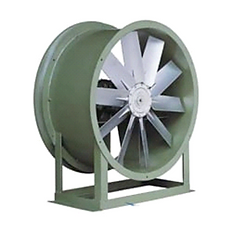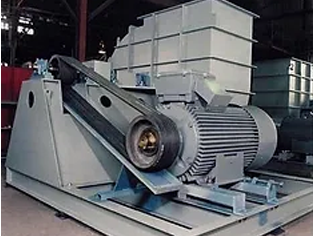
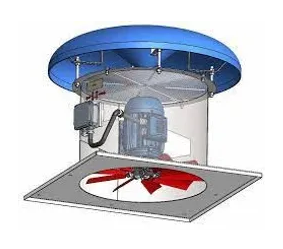
Motorised Roof Ventilator for Welding Workshop — Manufacturer & Supplier
Vayuvents Pvt. Ltd. manufactures and supplies motorised roof ventilators for welding workshop ventilation — providing general dilution ventilation, residual welding fume exhaust, and heat removal from fabrication shops, structural steel workshops, auto repair facilities, and industrial maintenance workshops.
Welding workshops present two ventilation challenges — local exhaust ventilation at each welding station to capture fumes at source (handled by axial booth fans), and general dilution ventilation throughout the building to manage residual fumes that escape local capture, remove accumulated heat from welding arcs and cutting, and maintain overall air quality for all workshop occupants.
Motorised roof ventilators are the standard solution for general dilution ventilation in welding workshops. Positioned at the roof apex where heat and residual fumes accumulate by buoyancy, they extract contaminated hot air from the building while fresh air enters at floor level through supply fans and natural openings.
The combination of local exhaust ventilation (axial booth fans) and general dilution ventilation (roof ventilators) is the recommended two-layer approach to welding workshop ventilation — the local extraction captures most fumes at source while the roof ventilators manage what escapes and maintain the overall building air quality.
How It Works in This Application
Fume and Heat Accumulation
Welding fumes and heat from welding arcs, cutting torches, and grinding operations rise by buoyancy and accumulate in the space below the workshop roof — gradually contaminating the entire building atmosphere.
Local Source Extraction
Axial booth fans at each welding workstation capture the primary fume concentration at source — the most important control measure. But some fumes inevitably escape local capture.
General Dilution Ventilation
Motorised roof ventilators extract the entire building atmosphere continuously, diluting and removing residual fumes that have escaped local capture and maintaining overall building air quality.
Fresh Air Supply
Fresh air enters through supply fans or natural openings at floor level and flows upward past workers to the roof ventilators, carrying residual fumes upward and away from the breathing zone.
Recommended Variants
Standard Motorised Roof Ventilator
Direct-drive axial impeller in GI or MS construction — most common for general welding workshop roof ventilation.
Most RecommendedEpoxy-Coated Roof Ventilator
Acid-resistant epoxy coating on MS or GI body for workshops handling stainless steel welding where chromium fume is mildly corrosive.
Large-Diameter Roof Ventilator
High-airflow large throat diameter units for large-span fabrication shops requiring maximum air changes per hour.
VFD Thermostat Roof Ventilator
Variable speed fan with thermostat for combined heat and fume management in welding shops with variable occupancy.
Technical Specifications
| Parameter | Specification |
|---|---|
| Airflow Capacity | 1,000 to 80,000 m3/hr |
| Static Pressure | Up to 40 mmWG |
| Motor Power | 0.18 to 15 kW |
| Throat Diameter | 400 to 1,600 mm |
| Body Material | GI / MS epoxy coated / SS304 |
| Motor Enclosure | IP55 TEFC |
| Standards | IS 4894, IS 3016 (welding ventilation), IS 6966 |
Key Features
- IP55 motor enclosure for reliable operation in the dusty, smoky welding workshop environment
- Epoxy-coated or GI body resists mild corrosion from stainless steel welding chromium fume residues
- Large throat diameter options for high air change rates in large-span fabrication shops
- Birdproof wire mesh guard with heavy-duty frame for the rugged welding workshop environment
- Thermostat or manual control for flexible operation — continuous during working hours, off outside shifts
- Low maintenance direct-drive construction eliminates belt wear and alignment in the dusty workshop
- Anti-vibration mounts for roof installation where overhead crane and heavy equipment vibration is present
- Works performance test certificate with measured airflow data
Industries That Use This Application
Fabrication Shops
MS fabrication, structural steel, and heavy fabrication workshops with multiple welding stations
Auto Repair Workshops
Large commercial vehicle and bus maintenance workshops with MIG and MMA welding
Pump & Valve Mfg
Welding and fabrication areas in pump, valve, and pressure vessel manufacturing plants
Shipbuilding
Shipyard covered workshops and dock buildings with extensive structural welding operations
Construction Equipment
Heavy equipment and agricultural machinery fabrication and repair workshops
Engineering Plants
Maintenance workshops and fabrication areas in large engineering and chemical plants
Electrical Equipment
Transformer and switchgear panel fabrication and welding workshops
Contract Workshops
General engineering and metal fabrication job shops with mixed welding and machining operations
✓ Supply & Support: Vayuvents manufactures motorised roof ventilators for welding workshops at our Vasai, Mumbai works. We supply for both new workshop construction and retrofit of existing inadequately ventilated workshops. Installation supervision available across India.
FAQs
A motorised roof ventilator alone is not sufficient — it provides general dilution ventilation but cannot adequately control welding fume concentration at the welder breathing zone without local exhaust ventilation. The recommended two-layer approach combines local exhaust ventilation (axial booth fans or fume arms at each welding station) with general dilution ventilation from roof ventilators. IS 3016 requires both layers of ventilation control for enclosed welding operations.
IS 3016 and industrial hygiene guidelines recommend a minimum of 20 air changes per hour for general welding workshops with multiple welding stations. For heavier welding with stainless steel or speciality alloys, higher rates may be required. For a 500 sq m welding workshop with 6m ceiling height, this requires approximately 60,000 m3/hr of exhaust airflow, typically provided by 3 to 5 roof ventilators.
Standard GI or MS roof ventilators are acceptable for most carbon steel welding workshops. For stainless steel welding workshops where chromium fumes are more corrosive, an epoxy-coated GI or SS304 body provides longer life than standard GI. The level of corrosion depends on the stainless steel alloy being welded and the ventilation rate maintaining fume dilution below corrosive concentrations.
Local exhaust ventilation (LEV) at each welding station captures the primary fume concentration at source — typically 80 to 95 percent of generated fumes. The remaining 5 to 20 percent escapes into the building atmosphere. Roof ventilators manage this residual fume through dilution ventilation, preventing accumulation over time in the building volume. Without roof ventilators, residual fumes accumulate over the shift and contaminate the entire workshop.
Yes. For mild steel (carbon steel) welding where manganese and iron oxide fumes are generated, roof ventilators providing the required air change rate maintain fume concentrations well below OSHA and Factories Act exposure limits for welding fumes. Stainless steel and chromium-containing alloy welding requires stricter controls due to the higher toxicity of hexavalent chromium fumes.
Roof ventilators should be positioned at the highest point of the workshop roof to extract the hottest, most contaminated air layer — typically at the roof ridge of a pitched roof or distributed across the roof of a flat-roof workshop. They should be positioned away from fresh air inlet openings to prevent short-circuiting where fresh air flows directly to the exhaust without sweeping through the working zone.
Contact Vayuvents at enquiry@vayuvents.com or call +91 90961 88703. Share your workshop dimensions, number of welding stations, welding process type (MIG, TIG, MMA, plasma cutting), and whether local exhaust ventilation is also required. We will provide a complete ventilation design and commercial proposal within 24 hours.