Motorised Roof Ventilator for Chemical Plant — Manufacturer & Supplier
Vayuvents Pvt. Ltd. manufactures and supplies corrosion-resistant motorised roof ventilators for chemical plant buildings — providing building ventilation, hazardous vapour dilution, heat exhaust, and emergency fume escape in chemical, petrochemical, pharmaceutical, and agrochemical manufacturing facilities.
Chemical plant buildings house process equipment, storage vessels, and reaction systems that generate chemical vapours, toxic gases, and heat. Adequate building ventilation is not only required for worker safety under the Factories Act, but is often a condition of process hazard analysis (PHA/HAZOP) recommendations and local fire authority requirements.
The choice of roof ventilator material is critical in chemical environments — salt spray, acid vapours, and solvent atmospheres rapidly corrode standard GI and MS construction. Vayuvents supplies roof ventilators in the correct material for each chemical environment.
We have supplied to chemical plants in Vapi, Ankleshwar, Dahej, Navi Mumbai, and export projects in UAE and Saudi Arabia — understanding the corrosion challenges of the full range of chemical manufacturing environments.
How It Works in This Application
Chemical Vapour Generation
Process equipment, storage tanks, and vessel vents generate chemical vapours that accumulate in the building atmosphere and must be continuously diluted to below hazardous concentration levels.
Roof Ventilator Dilution
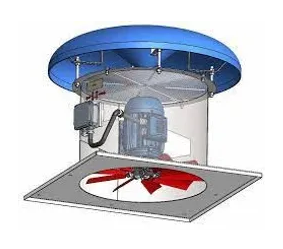
Motorised roof ventilators exhaust chemically contaminated building air at the roof apex, drawing in fresh air through wall openings to maintain dilution ventilation as required by HAZOP recommendations.
Heat and Vapour Exhaust
Chemical process equipment generates significant heat in addition to vapour emissions — the roof ventilator simultaneously exhausts both heat and chemical vapours from the building.
Emergency Vapour Release
In the event of an accidental release of toxic or flammable gas, roof ventilators on emergency mode provide rapid building air change to dilute the release below dangerous concentrations.
Recommended Variants
PP Roof Ventilator
Polypropylene construction for most mineral acid fume environments — hydrochloric acid, sulphuric acid, and alkali atmospheres.
Most RecommendedFRP Roof Ventilator
Fibreglass construction for stronger acid fumes, higher concentrations, and larger throat diameter requirements.
SS316L Roof Ventilator
Stainless steel for chlorine, nitric acid, and pharmaceutical chemical vapour environments not suitable for PP.
Explosion-Proof Roof Ventilator
Flameproof motor and spark-resistant impeller for Zone 1 and Zone 2 flammable vapour hazardous areas.
Technical Specifications
| Parameter | Specification |
|---|---|
| Airflow Capacity | 1,000 to 50,000 m3/hr |
| Static Pressure | Up to 40 mmWG |
| Motor Power | 0.18 to 11 kW |
| Throat Diameter | 400 to 1,400 mm |
| Body Material | PP / FRP / SS316 / GI |
| Motor Enclosure | IP55 / Flameproof Ex-d for hazardous areas |
| Standards | IS 4894, IS 5572, IS 6966 |
Key Features
- PP and FRP construction provides complete corrosion resistance for acid and alkali chemical vapour building atmospheres
- SS316L option for oxidising acid environments and pharmaceutical chemical processing atmospheres
- Flameproof (Ex-d) motor option for buildings classified as Zone 1 or Zone 2 hazardous areas
- Spark-resistant impeller material (PP, FRP, SS316) eliminates ignition risk for flammable vapour atmospheres
- All-plastic construction option (PP body and impeller) eliminates all metal contact in severe acid environments
- IP55 motor enclosure as standard for chemical plant outdoor roof environments
- Integral rain hood in same corrosion-resistant material as body to prevent rain ingress to chemical plant below
- Works performance test certificate with measured airflow and motor power data
Industries That Use This Application
Chlor-Alkali Plants
Roof ventilation for buildings housing chlorine handling, HCl absorption, and caustic production equipment
Fertiliser Plants
Ammonia, sulphuric acid, and nitric acid atmosphere building ventilation in fertiliser manufacturing
Pharmaceuticals
GMP pharmaceutical manufacturing building ventilation with SS or food-grade construction
Agrochemical Plants
Pesticide and herbicide manufacturing building ventilation with organic solvent atmosphere
Petrochemical
Building ventilation for pump houses, compressor rooms, and process buildings in petrochemical plants
Electroplating
Acid atmosphere building ventilation over chrome, nickel, and zinc plating bath areas
Specialty Chemical
Custom chemical synthesis building ventilation across the full range of specialty chemical manufacturing
Effluent Treatment
H2S and ammonia atmosphere building ventilation in covered effluent treatment process areas
✓ Supply & Support: Vayuvents manufactures corrosion-resistant roof ventilators in PP, FRP, SS, and GI at our Vasai, Mumbai works. We recommend the correct material based on your specific chemical atmosphere. Export supply to UAE, Saudi Arabia, Qatar, and Oman with full documentation.
FAQs
For sulphuric acid atmospheres, PP (polypropylene) roof ventilators are suitable for dilute acid concentrations and vapour environments. For concentrated sulphuric acid or high-concentration vapours, FRP provides greater strength and chemical resistance. SS316L is required for very concentrated sulphuric acid (above 80 percent) or for sulphuric acid at elevated temperatures.
Yes, for chemical plant buildings classified as Zone 1 or Zone 2 hazardous areas under IS 5572 due to the presence of flammable vapours (solvents, hydrogen, ammonia, chlorine above LEL), the roof ventilator motor must be flameproof (Ex-d) rated. For buildings classified as non-hazardous areas with only toxic vapours below flammable limits, standard IP55 motors are acceptable.
Dry chlorine gas at low concentrations can be handled by PP construction. Wet chlorine gas (chlorine dissolved in water vapour) is more corrosive and at high concentrations may attack PP over time. For high-concentration or wet chlorine environments, FRP or PVDF (polyvinylidene fluoride) construction is recommended. Please specify your chlorine concentration and moisture content when requesting a quote.
Chemical plant buildings requiring hazardous vapour dilution ventilation need 10 to 30 air changes per hour depending on the process hazard level — significantly higher than the 5 to 10 air changes for general industrial buildings. HAZOP recommendations and local fire authority requirements may specify higher rates for specific chemical processing areas. Vayuvents sizes roof ventilators based on your specific ventilation requirement.
Yes. Vayuvents supplies motorised roof ventilators with ATEX-certified flameproof motors and non-sparking PP, FRP, or SS316 impellers for installation in Zone 1 classified areas as defined under IS 5572 and IEC 60079. All electrical components must be rated for the hazardous area Zone 1 classification.
Yes. Vayuvents manufactures replacement roof ventilators to match existing dimensions and performance for all chemical plant applications. Send us the existing throat diameter, body dimensions, motor rating, and construction material and we will supply a matched replacement in the same or improved corrosion-resistant material.
Contact Vayuvents at enquiry@vayuvents.com or call +91 90961 88703. Share the chemical atmosphere type, concentration, building dimensions, hazardous area classification, and any specific material requirements. We will recommend the correct construction and provide a technical and commercial proposal within 24 hours.