Industrial Hot Air Blower for Space Heating — Manufacturer & Supplier
Vayuvents Pvt. Ltd. manufactures and supplies industrial hot air blowers for space heating applications — from small workshop heaters to large-capacity factory floor heating systems in cold-climate industrial locations including Punjab, Haryana, Himachal Pradesh, Rajasthan, and export markets in the Middle East and Central Asia.
Industrial space heating with hot air blowers provides the most rapid, uniform, and energy-efficient method of maintaining working temperature in large factory buildings, warehouses, and aircraft hangars. Unlike radiators that heat only the air near the floor, hot air blowers direct the heated airstream across the working zone, maintaining uniform temperature from floor to ceiling.
Industrial processes in cold-climate locations require minimum ambient temperatures for worker productivity, material handling, and in many cases for process reasons — paint application, adhesive bonding, and certain chemical reactions require minimum temperature levels that cannot be maintained by inadequate heating.
Vayuvents supplies hot air blowers for both electric-heated and steam/hot water-heated systems, matched to the building volume, required temperature rise, and ambient design temperature.
How It Works in This Application
Heat Source Selection
Heat is provided by electric heaters, steam coils, hot water coils, or gas burners — the heat source is determined by the available energy at the site and the scale of heating required.
Hot Air Generation
The hot air blower draws ambient air, passes it over the heat exchange surfaces, and discharges heated air at the required temperature (typically 30 to 60 degrees Celsius for space heating).
Directed Hot Air Distribution
The blower discharge is directed by ductwork or by the blower orientation to specific zones requiring heating — floor level and near doorways and loading docks where cold air infiltration is greatest.
Uniform Building Temperature
Multiple hot air blowers with ductwork or ceiling jet nozzles distribute heated air uniformly throughout the building volume, maintaining consistent floor-to-ceiling temperature without cold spots.
Recommended Variants
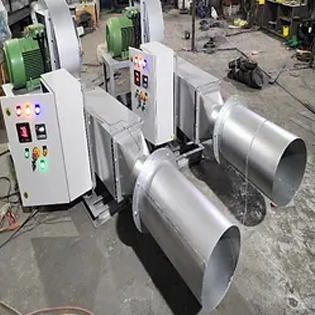
Electric Hot Air Blower
Self-contained electric heater and blower unit — simplest installation, ideal for smaller spaces and backup heating.
Most RecommendedSteam Coil Hot Air Blower
Blower with steam heat exchanger coil — for locations with existing steam supply from process boilers.
Hot Water Coil Blower
Blower with LPHW (low-pressure hot water) coil — most common for large building heating using central boiler plant.
Duct-Mounted Hot Air Heater
In-duct hot air blower integrated into a central HVAC duct system for multi-zone building heating.
Technical Specifications
| Parameter | Specification |
|---|---|
| Airflow Capacity | 2,000 to 1,00,000 m3/hr |
| Outlet Temperature | 35 to 80 degrees Celsius (space heating) |
| Heating Capacity | 5 kW to 500 kW |
| Motor Power | 0.37 to 37 kW |
| Impeller Material | MS / Aluminium / SS |
| Heat Source | Electric / Steam / LPHW |
| Standards | IS 4894, BEE energy efficiency guidelines |
Key Features
- Rapid heat-up of large factory spaces — hot air blowers provide faster temperature rise than radiator or underfloor systems
- Directed airflow distribution ensures uniform temperature throughout the building without cold spots near walls and roof
- Thermostat control for automatic temperature maintenance — reduces energy consumption when set point is reached
- Low-pressure drop design for energy-efficient air distribution through extensive factory ductwork
- Multiple smaller units more flexible than single large unit — zone control allows heating only occupied areas
- Variable speed drive compatible for matching heat output to ambient temperature and occupancy
- Suitable for hazardous area installation with appropriate Ex-rated heater elements and flameproof motor
- Works performance test with measured airflow and heat output at design conditions
Industries That Use This Application
Industrial Factories
Large manufacturing factories in cold-climate North and West India states requiring winter heating
Warehouses & Logistics
Cold-climate warehouses and distribution centres where goods handling requires minimum temperature
Aircraft Hangars
Large-span aircraft maintenance hangars requiring rapid and uniform heating in cold weather
Railway Workshops
Locomotive and rolling stock maintenance workshops requiring winter heating in northern India locations
Construction Sites
Temporary building heating during winter construction — concrete curing, plaster setting, and enclosure heating
Agricultural Processing
Winter heating in grain processing, dal mills, and agricultural commodity processing in Punjab and Haryana
Auto Workshops
Large commercial vehicle and bus maintenance workshops in cold-climate depot locations
High-Altitude Facilities
Industrial facilities in high-altitude locations in Himachal Pradesh, Uttarakhand, and Ladakh
✓ Supply & Support: Vayuvents manufactures industrial space heating hot air blowers at our Vasai, Mumbai works. We supply to industrial facilities in cold-climate northern India states and export to Central Asia, Afghanistan, and Middle East locations requiring building heating.
FAQs
Hot air heating using high-efficiency heat exchangers (steam or hot water coils) connected to central boiler plant is the most energy-efficient method for large factory space heating. The centralised heat generation achieves higher efficiency than multiple distributed electric heaters, and the hot air distribution system ensures uniform temperature throughout the building. Vayuvents designs hot air blower systems optimised for energy efficiency.
The number depends on the required temperature rise, building insulation, and infiltration rate. For a poorly insulated 5,000 sq m factory with 8m height in a North India location requiring heating from 5 to 18 degrees Celsius, the heat load is approximately 500 to 800 kW, requiring 3 to 5 units of 150 to 200 kW hot air heaters. Vayuvents provides heat load calculations and blower sizing for your specific building.
Worker productivity improvements, reduced material scrap (cold adhesive bonding, paint application failures), and prevention of equipment and product damage from cold temperatures typically justify industrial space heating investment within 1 to 2 years. In northern India states like Punjab and Haryana where winter temperatures drop to 2 to 5 degrees Celsius, factory heating is a productivity necessity rather than a luxury.
Yes. Electric hot air blowers with self-contained heater elements are ideal for temporary or emergency heating as they require no external heat supply and can be positioned and started immediately. Vayuvents supplies portable and semi-permanent electric hot air blower units for temporary construction site and emergency heating applications.
Yes. While the Gulf region is known for heat, industrial facilities in Saudi Arabia and UAE require heating during winter months when temperatures drop to 5 to 15 degrees Celsius at night in desert inland locations. Vayuvents exports hot air blowers to these locations with 50-Hz 415V 3-phase supply and full export documentation.
An industrial fan heater is a compact self-contained unit with integrated electric heating elements and a small axial or centrifugal fan — suitable for small spaces up to approximately 500 sq m. A hot air blower system uses a dedicated centrifugal blower connected to a steam, hot water, or large electric heat exchanger — for large factory and warehouse heating from 500 to 50,000 sq m. Vayuvents supplies both types.
Contact Vayuvents at enquiry@vayuvents.com or call +91 90961 88703. Share your building dimensions, minimum and maximum ambient temperatures, required indoor design temperature, available heat source (electric, steam, hot water), and occupancy pattern. We will conduct a heat load calculation and provide a full heating system design and commercial proposal within 24 hours.